
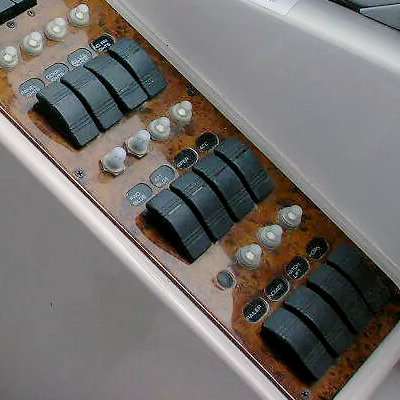
Rocker switches are found on the dashboard of almost every boat and yacht. They are a reliable and user-friendly way to control various electrical systems, including accent lighting. But if you have ever had to replace one or thought about adding another switch, you know it is not as simple as grabbing one off the shelf.
The right switch is critical when adding underwater or deck lighting to your vessel. This guide is designed to help clear the confusion and ensure you get the right switch for your needs.
What are Rocker Switches?
Rocker switches are electromechanical devices used to open or close an electrical circuit. They’re characterized by their distinctive flat, paddle-like actuator that rocks back and forth to operate the circuit. This makes the switch easy to operate, even in rough conditions or with wet hands. This simple design makes them a popular choice for marine applications.
How Do They Work?
Inside a rocker switch, the actuator is connected to a contact. When the actuator is pressed in the ON direction, the contact closes, completing the circuit and sending current through it. When the actuator is pressed in the OFF direction, the contact is open, stopping current through the circuit. These actions control the power of your lights, allowing you to turn them on and off.
This describes the simplest type of switch. But of course, things get more complicated from there.

Understanding Switch Terminology
To understand rocker switches, it helps to first understand a few key terms:
- Direct Current (DC): Direct current flows along a wire in only one direction instead of occasionally changing direction as AC current does. While some boats may also have an Alternating Current system, most rely on DC power supplied by a battery system.
- Load: A device in a circuit that uses electricity, such as an LED light.
- Circuit: A current traveling through wires from the battery’s positive to its negative terminal in a closed loop.
- Pole: The number of separate circuits a switch can control. A single pole can control more than one circuit.
- Single Pole (SP): A switch that controls only one circuit.
- Double Pole (DP): A switch that controls two separate circuits simultaneously.
- Throw: In simple terms, it’s the number of ON positions a switch has. For example, an ON/OFF switch has one throw, while an ON-OFF-(ON) switch has two throws.
- Single Throw (ST): A switch that can only connect to one circuit path (e.g., ON or OFF).
- Double Throw (DT): A switch that can connect to two different circuit paths (e.g., ON-NONE-ON)
- Maintained: A maintained switch stays in its set position until it is moved. In other words, if the switch is on, it remains on until you turn it off.
- Momentary: A momentary switch closes a circuit while being pressed. Once released, the circuit opens, and the actuator returns to its original position. These switches are commonly used in applications such as horn buttons or trim tabs, where momentary activation is required. For lighting, they can be used with Shadow-NET-enabled lights such as RGB spreaders and RGB underwater yacht lights.
Types of Rocker Switches for Marine Lighting:
There are two rocker switch configurations commonly used for controlling boat and yacht lighting:
- SPST (Single Pole, Single Throw): The most common type controls a single circuit with one ON/OFF position. It is ideal for controlling a single light or a group of lights. This switch is commonly used to control single-color lights but can also change the color and brightness of Shadow-NET-enabled RGB lights.
- SPDT (Single Pole, Double Throw): This switch has one circuit with two throws, a maintained ON, and a momentary (ON). The (ON) adds advanced control of Shadow-NET-enabled lights.
Why Use Marine Grade Switches:
- Water Resistance: Your rocker switches are designed to withstand getting wet. Look for switches with a high IP (Ingress Protection) rating, such as IP67 or higher, to ensure they are sealed against water and dust.
- Corrosion Resistance: Saltwater is highly corrosive; therefore, choose switches made from corrosion-resistant materials, such as marine-grade stainless steel or durable plastics.
- Current Rating: Ensure the switch’s current rating is sufficient for the load of the lights it will be controlling. LED lights generally draw relatively low current, but it’s always best to check the specifications of your Shadow-Caster lights.
- Mounting: Many rocker switches use snap-in mounting and customizable actuators.
Choosing the Right Rocker Switch for Your Shadow-Caster Lights:
SPST rocker switches are all you need for single-color Shadow-Caster LED lighting applications. They provide simple and reliable ON/OFF control for single-color underwater, courtesy, spreader, and downlights. Additionally, they will change the brightness and toggle through the light colors of two- and three-color lights, or toggle through 12 preset colors and adjust the brightness of Shadow-NET-enabled RGB lights.
An SPTD momentary switch ((ON)-OFF-ON) is an even better choice for Shadow-NET-enabled lights. With it, two—and three-color lights can fade from one color to the next or strobe in whatever color the light is set to. RGB lights will fade between blue and white, or all colors, rotate through all colors, or strobe in the color the light is set to.
Amp Rating: Most single-color LED lights draw very little current, but some high-power lights, such as underwater, spreader, and downlights, draw more amperage than a rocker switch can handle, especially when there are two or more lights in a single circuit. Before buying a switch, add the total amperage of the lights you will connect to it. The Shadow-Caster SCM-PD4CH power distribution block can be used with underwater lights to solve this problem. It powers and protects up to four single-color, multi-color, or color-changing lights.
DC Rule of Thumb: Some switches show only an AC voltage rating. It can be assumed that these switches will handle their highest amperage rating at 30 volts DC.
I hope this guide has given you the knowledge to make informed decisions about rocker switches for your boat or yacht. From simple on/off control to more complex configurations, the right switch can make all the difference in how you experience your time on the water. If you did, please share this guide with your fellow boaters to help them understand the importance of selecting the proper switch for marine lighting.